3-4 Minute Read
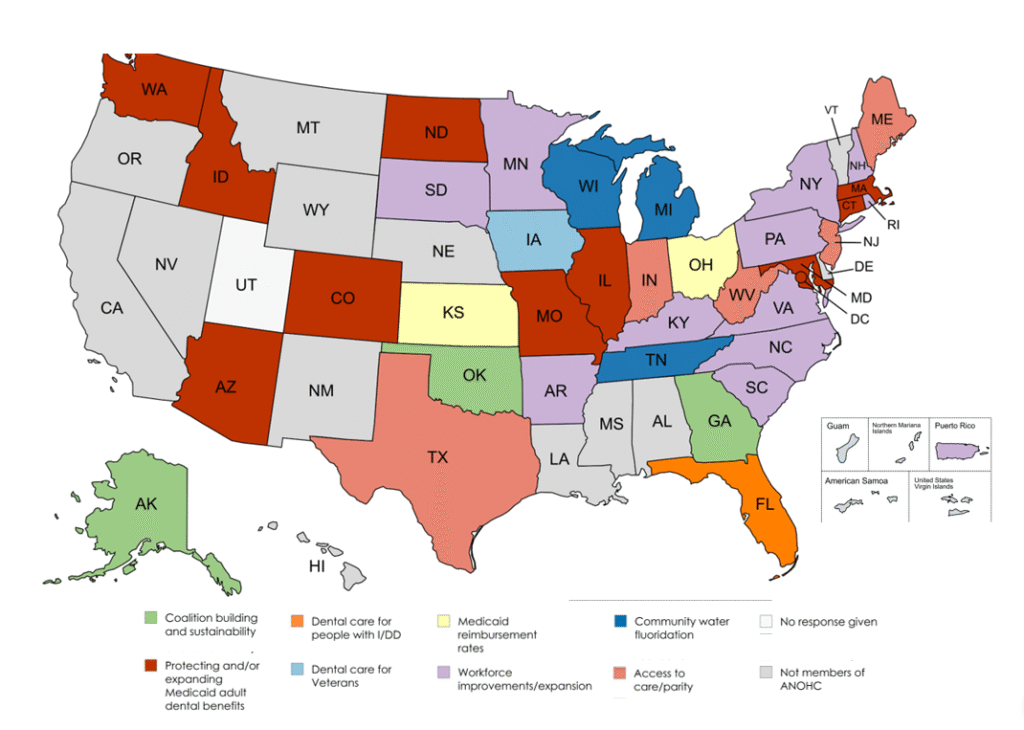
ANOHC’s 2026 State Top Issues Map shows what each of its 40 member coalitions named as their top priority that year, everything from Medicaid dental coverage to workforce shortages to water fluoridation. The issues look different state by state, but they add up to one connected story: coalitions across the country working toward the same goal from different starting points.
Look at the map below, and the first thing you’ll notice is how much variety there is. Washington and North Dakota are focused on protecting Medicaid adult dental benefits. Wisconsin and Michigan are prioritizing community water fluoridation. Texas and Arkansas are working on access to care. Georgia and Alaska are investing in coalition building and sustainability. Eight colors, dozens of states, no two coalitions working from an identical playbook.
That’s exactly the point.
Every state and territorial coalition operates in its own environment, its own population, its own legislature, its own dental workforce, its own funding picture. A coalition in a large rural state and a coalition in a small urban one are never going to have the exact same to-do list. So, it makes sense that when ANOHC asked its members to name their top issue for 2026, the answers spread across eight different categories: access to care and parity, Medicaid adult dental benefits, Medicaid reimbursement rates, workforce improvements and expansion, community water fluoridation, dental care for veterans, dental care for people with intellectual and developmental disabilities, and coalition building and sustainability.
What’s striking isn’t the variety, though. It’s how closely related these “different” issues really are. A state working on workforce shortages and a state working on Medicaid reimbursement rates are both, at bottom, trying to answer the same question: can people actually get a dental appointment when they need one? A coalition prioritizing care for veterans and a coalition prioritizing care for people with intellectual and developmental disabilities are both working to make sure the system serves everyone, not just the easiest patients to reach. Even coalition sustainability, which might look like an “internal” priority, is really about protecting the infrastructure that makes every other issue on this list solvable. A well-supported coalition is what keeps Medicaid advocacy, workforce programs, and prevention campaigns moving year after year, through changes in funding and leadership.
That’s what makes this map more than a snapshot, it’s the whole ANOHC story told in a single visual. Forty coalitions, representing states and territories across the country, each choosing the entry point that makes the most sense for the community they serve. Together, their members advocate for roughly 285 million Americans. Zoom in, and you see 40 distinct priorities. Zoom out, and you see one network, pulling in the same direction, learning from each other along the way. A coalition that’s already navigated a Medicaid reimbursement fight has something to offer a coalition just starting that conversation. A state experimenting with a new workforce model can pass those lessons to a state still searching for one.
The map will look different next year, and the year after that. Priorities shift as policy changes, funding moves and coalitions grow. But the underlying picture is likely to hold: diverse challenges, a shared mission, and a network built to connect the two.
FAQ
What is the ANOHC State Top Issues Map?
It’s a visual summary of the top oral health priority named by each of ANOHC’s 40 member coalitions in 2026, covering issues like Medicaid dental benefits, workforce shortages and access to care.
Why do different states and territories have different top priorities?
Each coalition operates in its own policy, population and funding environment, so their most urgent issue naturally varies, even though most of these issues connect back to the same goal of improving access to dental care.
What is ANOHC?
The American Network of Oral Health Coalitions, a national network of 40 state and territorial oral health coalitions whose members collectively advocate for about 285 million Americans.
How does ANOHC help coalitions with different priorities learn from each other?
By connecting coalitions across state lines so a coalition that has already tackled an issue, like Medicaid reimbursement or workforce shortages, can share what worked with a coalition just starting out.
Explore ANOHC’s network of state and territorial oral health coalitions and see how members across the country are advancing policy, prevention and access to care.